Mission, chapel-school and parish growth
The Diocese of Motherwell’s 2019 historical account says a separate Catholic mission was formed in 1877, after the area had been served from Hamilton. Before a purpose-built chapel-school, Mass and Sunday school were reportedly held in adapted accommodation at Dixon’s Rows. A two-storey chapel-school was solemnly opened on 24 October 1878; the upstairs served as a church with seating for 62, while the ground floor and side wing formed the school, reportedly accommodating 514 pupils. The same narrative describes a small school at Auchintibber and later growth in school attendance.
The retrospect identifies Thomas Frawley as the first resident priest, appointed in August 1877, and discusses Peter Donnelly’s ministry from 1881 to 1886. The 1952 Third Statistical Account lists St Joseph’s among Blantyre’s schools and describes its church on Glasgow Road, giving a later independent time-slice rather than a continuous institutional record. The Catholic Archives catalogue confirms a fonds spanning 1877–1953, but its contents have not been examined. Education in Blantyre · Scottish Catholic Archives catalogue SCA/MP/496
The 1905 building
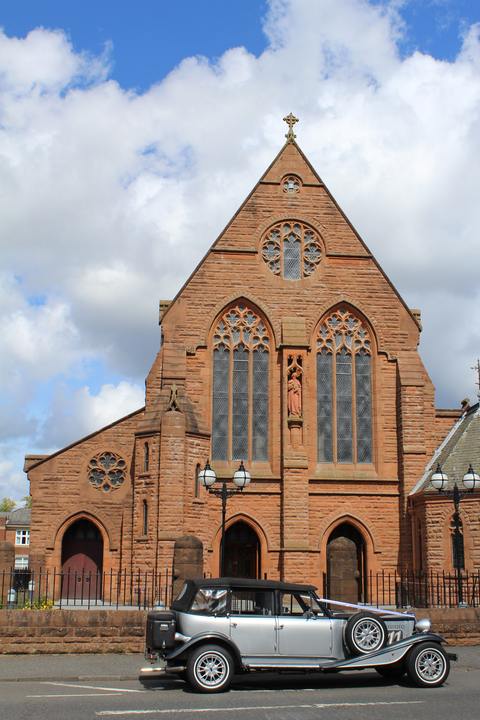
HES lists the present St Joseph’s church as Category B (LB50018), added 29 November 2004; the catalogue evidence is recorded in hes st josephs catholic church. The listing describes a tall, rectangular Gothic-detailed church in bull-faced red sandstone with polished ashlar dressings, a seven-bay nave, side aisles incorporating chapels and confessionals, a polygonal stair tower, and a former baptistry oratory. It names Pugin and Pugin and dates the building to 1905. The listing situates the church on Glasgow Road beside the Livingstone Memorial Church and links the setting to Blantyre’s coal-mining prosperity. HES listing LB50018
The HES account gives the opening date as 18 June 1905 and names officials at the opening, including Archbishop of Glasgow John Maguire. It identifies a sequence of interior changes: possible vestry and sacristy additions in 1924; marble reredos and altar designed in 1928 by Ernest Schoefelberg, with redecoration and stencilling by Glasgow firms and John Hardman Studios; an east rose window installed in 1948; and further Hardman work in 1954. HES cites the Hamilton Advertiser of 24 June 1905 and architectural scholarship, offering a path for further checking. It also explains that its detailed description is supplementary and not the legally operative part of the designation.
Mining disaster and religious memory
The Diocese of Motherwell retrospective, catalogued here as diocese of motherwell st joseph, describes the October 1877 disaster as devastating for Catholic families and reports that a commemorative monument to Catholic victims stood at Dalbeth Cemetery. It gives a figure of “some 230” dead, about half Catholic. This is at odds with totals in the inquiry and contemporary accounts already examined for Blantyre mining disaster of 1877, including the inquiry-derived total of 209 and the NLS directory’s 212; the denominational account’s underlying text and counting method are unclear. The estimate is retained as evidence of Catholic collective memory and a further lead, not as the accepted death toll. The exact monument, inscription, present location and archival provenance need investigation.
Exterior photograph