Mission, meeting place and permanent church
The dates used for the congregation’s beginning describe different stages. HES says meetings began in domestic premises in 1876 and that a wooden church was built on the site in 1878. NRS catalogue CH3/618 records the Livingstone Memorial United Presbyterian Church as originating as a mission at Stonefield in 1877; after six months it came under Cambuslang Kirk’s supervision, and a church was purchased and opened for worship in June 1878. These accounts can be read as home meetings, a recognised mission and a temporary building, rather than forcing one date to serve every meaning of “foundation.” The NRS catalogue covers the congregation’s records from 1877 to 1986 but the records themselves have not been consulted. NRS catalogue CH3/618
A local-history article attributed to Gordon Cook provides a more detailed narrative of the temporary structure and the transition to a permanent memorial church; the source and its limitations are recorded at blantyre project livingstone memorial church. It describes a reused wooden church hut opened in June 1878, membership exceeding 100 by the end of that year, recognition as a United Presbyterian congregation in early 1879, and a building committee formed in 1880. Plans by McKissack & Rowan were adopted in November 1880. The permanent church opened on 17 September 1882, according to this account.
The memorial purpose appears in both the local narrative and the church’s name. The local account says the committee required a part of the building to be “distinctly a memorial to Livingstone” and describes a niche in the tower, while acknowledging that a story about the Livingstone family initiating the request is tradition rather than established fact. No unverified family role is asserted here. David Livingstone and Blantyre
Architecture and associated buildings
HES dates the Gothic-style rectangular-plan church to 1880–82 and names John McKissack and William Gardner Rowan. It is built of cream sandstone with ashlar dressings and a slate roof, with a tower and spirelet. The recorded interior includes tall cast-iron columns supporting pointed aisle arches, a decorated waggon roof representing land, sea and sky, and a timber organ screen, pulpit, choir rails and communion seat. The listing’s description is supplementary rather than a complete architectural history.
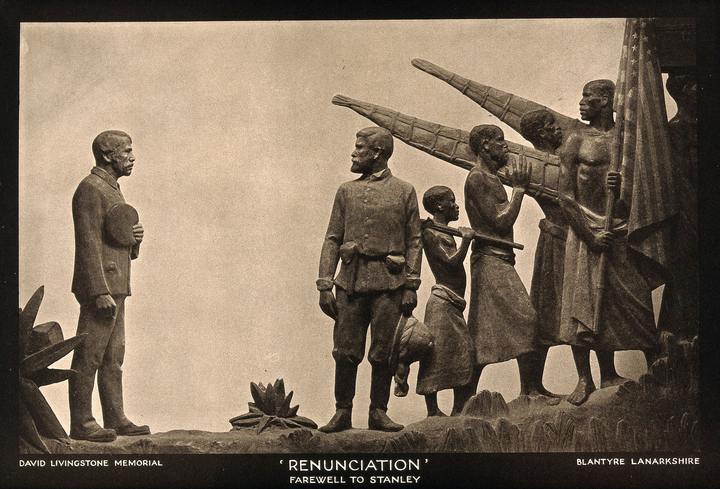
The listed group also includes a church hall dated 1894, a statue of David Livingstone by Kellock Brown dated 1913, and a manse dated 1929. This multi-building sequence shows the church as a developing institutional complex rather than a single construction event. HES cites Rev. Thomas A. Hugh’s History of Livingstone Memorial Church Blantyre (1927) and Links with the Past (1939); locating these works is a clear route to deepen the building, statue and congregation chronology.
Denominational change and Blantyre context
NRS records that the congregation became Livingstone Memorial United Free Church following the 1900 union of the United Presbyterian and Free churches. In 1929, following union with the Church of Scotland, it became Livingstone Memorial Church of Scotland, retaining the church buildings and manse. These institutional changes occurred while Blantyre’s population and coal economy were growing. The Third Statistical Account lists Livingstone Memorial as one of five Church of Scotland congregations in 1952 and reports 422 members, a period-specific administrative count rather than attendance. Religious life in Blantyre in 1952
The church stood in a mixed institutional landscape on Glasgow Road. HES notes its location next to St Joseph’s Catholic Church, whose current listed building opened in 1905. Their proximity is evidence of different congregations sharing a central urban corridor; it does not establish the social relationships between them. St Joseph’s Catholic Church, Blantyre
The 1913 memorial statue